- Part 1: The Architecture — How $126.9 Million Rewired American Foreign Policy
- Part 2 (You Are Here): The $26 Billion Vote — Who Got Paid, Who Got Eliminated
- Part 3: The Assassination of Dissent — Bowman, Bush, and the $23.5 Million Warning
- Part 4: The Embassy Deal — How $20 Million Bought a Foreign Policy Reversal
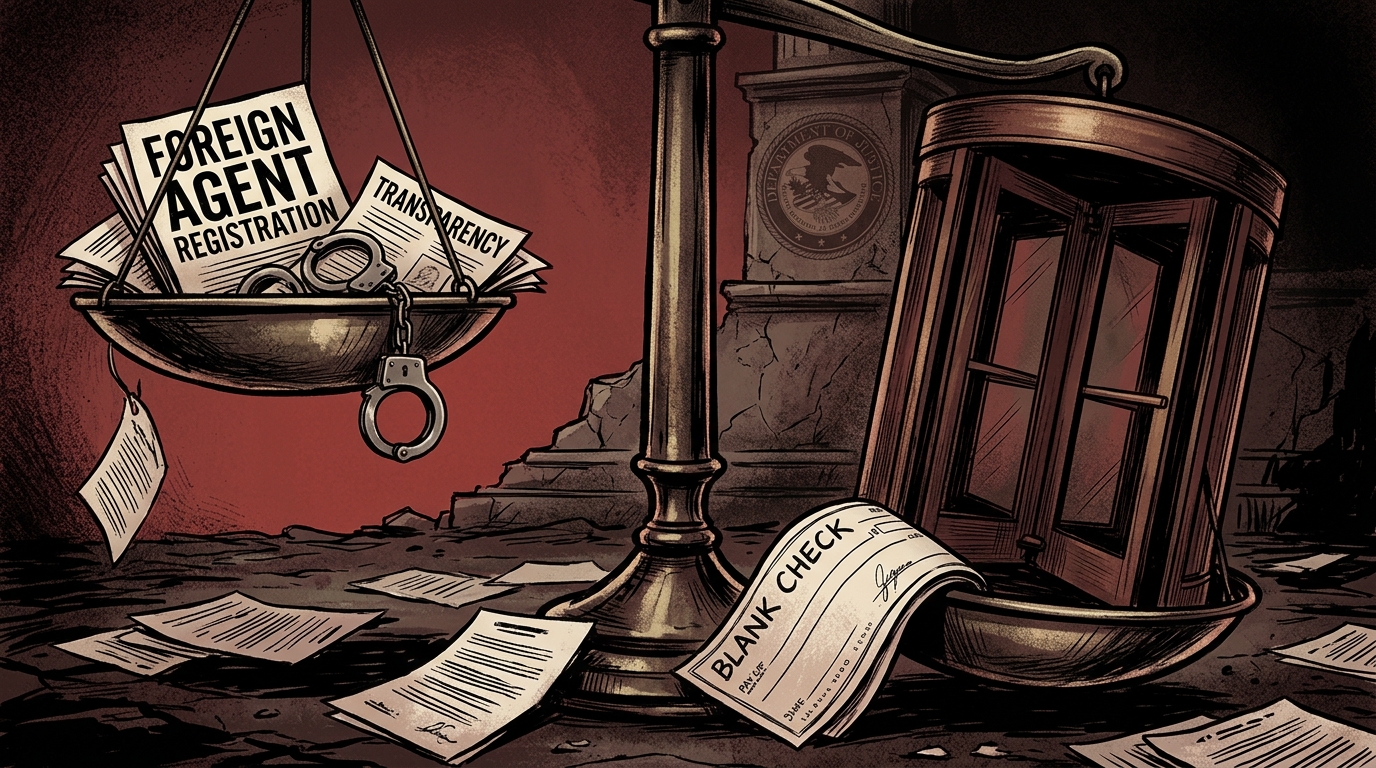
- Part 5 (You Are Here): The FARA Loophole — How a Foreign Lobby Escaped Foreign Agent Registration
- Part 6: The Veto Machine — 45 Times America Said No to the World
- Part 7: The Scorecard — How AIPAC Grades and Controls Every Member of Congress
- FARA: Foreign Agents Registration Act (1938) — requires disclosure when acting on behalf of foreign governments
- DOJ investigation of AIPAC under FARA: 1988 — closed without action
- AIPAC's argument: It represents American donors, not the Israeli government
- The problem: AIPAC coordinates messaging directly with Israeli government officials and has hosted Israeli government briefings for U.S. lawmakers
- Result: 35+ years of zero FARA enforcement against the most powerful foreign-interest lobby in Washington
The Foreign Agents Registration Act was passed by Congress in 1938, in direct response to Nazi Germany's propaganda operations in the United States. The law's premise was simple and bipartisan: if you are acting on behalf of a foreign government to influence American policy, the American public has a right to know. You must register. You must disclose. You must be transparent about whose interests you are actually serving.
AIPAC has spent $126.9 million on American elections in a single cycle. It coordinates with the Israeli government on messaging and legislative priorities. It hosts Israeli government officials at its annual conference, where sitting members of Congress receive briefings on Israeli government policy positions. Its super PAC has spent tens of millions eliminating members of Congress whose positions diverged from official Israeli government policy.
It has never registered under FARA. It has never disclosed its coordination with the Israeli government. It has never been required to identify itself as operating in a foreign government's interest.
This is the loophole at the center of American foreign policy corruption. Understanding how it works — and why it has persisted for 35 years — is essential to understanding why the money trail this series has documented is legal.
How FARA Works (In Theory)
FARA requires registration when a person or organization acts as an "agent of a foreign principal" — meaning they act at the direction of, or in the interest of, a foreign government, political party, or entity. Registration requires disclosure of the foreign principal, the nature of the relationship, and all political activities conducted on the foreign principal's behalf.
Violations of FARA are federal crimes. Convictions carry up to five years in prison. The DOJ prosecuted FARA cases aggressively in the 1940s and 1950s, successfully requiring disclosure from German, Soviet, and other foreign government agents. In recent decades, FARA enforcement collapsed. Between 1966 and 2015, the DOJ obtained exactly seven convictions under FARA. The law exists on paper. Its enforcement does not exist in practice.
The 1988 Investigation and Its Legacy
In 1988, the DOJ opened a formal investigation into whether AIPAC should be required to register under FARA. The investigation was serious — agents interviewed AIPAC officials, reviewed its organizational structure, and analyzed its relationship with the Israeli government and the Jewish Agency for Israel.
The investigation was closed without action. AIPAC was not required to register. The DOJ's reasoning, never fully made public, appears to have rested on the argument that AIPAC's relationship with Israeli government entities was insufficiently direct to trigger FARA's "agent of a foreign principal" standard.
That conclusion has shaped 35 years of non-enforcement. No subsequent administration — Republican or Democrat — has revisited it, despite the dramatic expansion of AIPAC's political operations, spending, and documented coordination with Israeli government officials.
The Coordination Evidence
What makes the FARA question particularly acute is the documented evidence of AIPAC's coordination with the Israeli government. This is not speculation. It is a matter of public record:
The AIPAC annual policy conference — attended by virtually every senior member of Congress, both parties — features Israeli government officials as headlining speakers. Israeli prime ministers, defense ministers, and intelligence officials brief American lawmakers at an event organized and funded by AIPAC. These briefings are coordinated with the Israeli government's communications office. The content of U.S. lawmakers' subsequent floor statements often closely mirrors Israeli government talking points transmitted through the conference.
AIPAC-funded congressional junkets to Israel — organized through AIPAC's educational arm, the American Israel Education Foundation — bring dozens of members of Congress to Israel annually for tours coordinated by Israeli government agencies. The 2023 trip taken by Rep. Donald Davis (D-NC) just before he broke with his party to vote against Palestinian humanitarian aid is one documented example; the pattern is systematic and bipartisan.
The 2005 AIPAC espionage case — in which two senior AIPAC lobbyists, Steve Rosen and Keith Weissman, were indicted for receiving and transmitting classified U.S. government information obtained from Defense Department official Larry Franklin — revealed the intimacy of AIPAC's intelligence relationships with Israeli government officials. The charges were ultimately dropped in 2009, but the case documented coordination between AIPAC officials and Israeli Embassy personnel that would have been difficult to explain under any reading of FARA that took the statute seriously.
Why the Loophole Persists
AIPAC's FARA exemption persists for the same structural reason every other AIPAC-related accountability measure fails: the people who would have to close the loophole are the people who benefit from it remaining open.
The Department of Justice is led by an Attorney General appointed by a president. Presidents receive pro-Israel lobby money. Attorneys General are confirmed by senators who receive pro-Israel lobby money. The congressional oversight committees that could demand FARA enforcement are populated by members who receive pro-Israel lobby money. The constitutional lawyers who might champion FARA reform work at firms that lobby for clients who receive AIPAC support.
There is no independent actor with both the motivation and the authority to force the issue. The system is self-sealing. AIPAC's money flows to the people who would have to decide to investigate AIPAC's money. The circularity is not accidental. It is the architecture.
The Double Standard
The most revealing test of the FARA enforcement gap is the comparison to other foreign-interest lobbying operations that have been required to register.
The Turkish government's lobbying operation — far smaller in scale than AIPAC's — has resulted in FARA registrations for multiple firms. Chinese government-linked media operations have been required to register. Russian government-linked organizations were prosecuted aggressively in the post-2016 environment. The Saudi government's lobbying, while extensive, operates through registered agents.
AIPAC alone — the largest, most politically powerful, and most documented foreign-interest lobbying operation in Washington — remains unregistered. The disparity is not explained by the law. It is explained by the money.
Tomorrow in Part 6: The Veto Machine — how the United States has cast over 45 Security Council vetoes to protect Israeli military operations from international accountability, and the direct line from AIPAC donations to American diplomats voting no while 120 nations vote yes.
- DOJ FARA Unit: Registration data and enforcement history, 1966–2024
- The Nation: "AIPAC Is Not What It Claims to Be" — FARA analysis
- Grant F. Smith, Institute for Research: Middle Eastern Policy — AIPAC FARA investigation records (FOIA)
- DOJ v. Franklin, Rosen, Weissman, E.D. Va. (2005)
- FARA statute: 22 U.S.C. §§ 611-621